We’re Not Just Building Awareness. We’re Trying to Change Culture.
Our new Unaltered State billboards are getting exactly the reaction we hoped for.
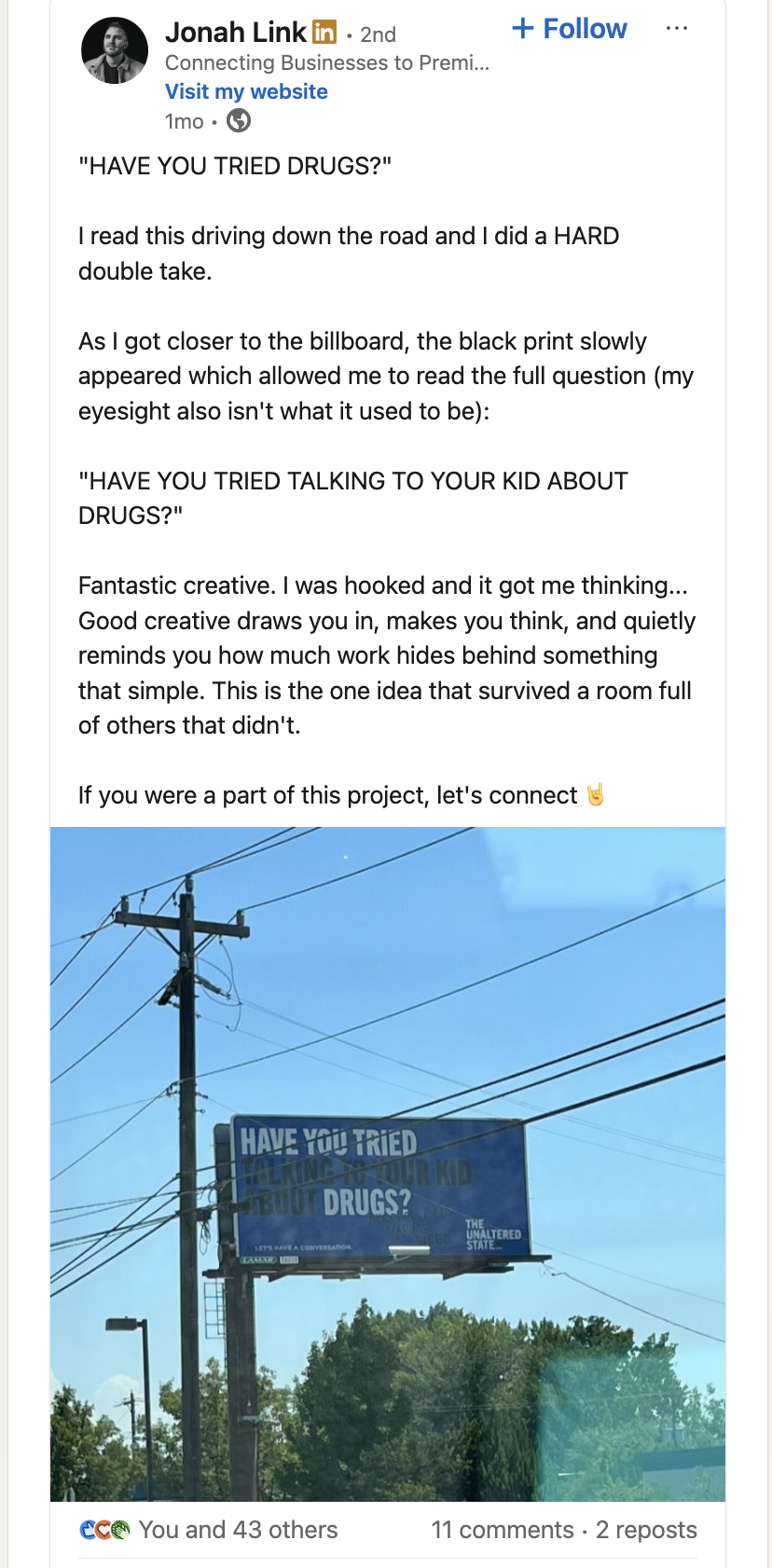
From a distance, drivers see:
“HAVE YOU TRIED DRUGS?”
As they get closer, the full message appears:
“HAVE YOU TRIED TALKING TO YOUR KID ABOUT DRUGS?”
People are doing double takes, taking pictures and sharing the billboard online. That reaction captures what we are trying to accomplish with Unaltered State 2.0.
We don’t want people to see another anti-drug ad and keep driving. We want parents to reconsider what prevention looks like—and teens to question who and what may be influencing their choices.
The billboard isn’t meant to do all the work. Its job is to interrupt and invite a second look; the broader campaign provides the information and resources behind it.
Ultimately, we are trying to change culture.
The conversation is prevention
Statewide research conducted last year revealed a striking disconnect: 95% of Idaho parents said they had talked with their kids about substance use, yet roughly one in three teens said those conversations either weren’t happening or weren’t meaningful.
That doesn’t mean parents aren’t trying. It means the conversations may not be quite sticking the landing.
One Idaho parent told us that when she passed one of the billboards with her children, they immediately said, “We’ve never had that conversation, Mom!” She thought they had. Her children didn’t see it the same way.
Parents don’t need to become substance-use experts or deliver one perfect “drug talk.” They need to talk early, talk often, ask questions and listen.
Some parents worry that raising the subject will make kids curious. But young people are already surrounded by messages about substances. Talking about them doesn’t create the risk; it gives parents an opportunity to shape the conversation before someone else does.
The landscape has changed
Our research also found that one-in-three Idaho parents still views youth substance use as a rite of passage.
Adults may remember experimentation from their own adolescence and assume today’s teenagers are encountering essentially the same things. They aren’t.
Teenagers haven’t fundamentally changed. The landscape around them has.
Today’s young people face highly concentrated nicotine vapes, stronger THC products, discreet nicotine pouches and the deadly risk of fentanyl. They are also navigating smartphones, social media and nearly constant exposure to marketing and influence.
Our goal isn’t to frighten parents. It is to help them understand the world their kids are actually navigating.
Who benefits if kids start using?
We are also changing how we speak to teens.
Our research showed that Idaho kids understand the dangers of drug use. And best practices tell us that instead of preaching, exaggeration and fear-based messaging, young people respond to credible information they can evaluate for themselves.
So instead of simply telling teens, “Don’t use,” we are asking bigger questions:
Who benefits if you start? Who makes money if you continue? How much research, marketing and product development went into getting your attention?
Companies selling nicotine, alcohol, marijuana and other substances have a financial incentive to create customers and keep them. Flavors, packaging, advertising, social media and product design all influence behavior.
Young people don’t appreciate being manipulated. Choosing not to use can be more than following an adult’s instructions. It can be refusing to let someone else make that decision for you.
From awareness to culture change
The first phase of Unaltered State built awareness around youth substance use in Idaho. With Unaltered State 2.0, we want to go further.
We want more meaningful family conversations, greater understanding of today’s drug environment and less acceptance of youth substance use as an inevitable part of growing up. We want teens to recognize the forces competing for their attention and feel confident making informed decisions for themselves.
Culture won’t change because of one billboard, television spot or conversation. It changes when enough people begin questioning old assumptions and thinking differently.
We’re not just trying to make Idaho more aware of youth substance use. We’re trying to change what Idaho considers normal.